
TL;DR
A good kids martial arts program should do more than promise confidence, discipline, focus, respect, fitness, and self-defense. Parents should look at what children are actually learning, how coaches teach and correct them, whether the challenge is appropriate for their age and readiness, how safety and behavior are handled, and whether advancement reflects real development rather than simply time spent in class. The strongest programs give children meaningful skills to learn, clear expectations to meet, appropriate challenges to work through, and progress they can recognize for themselves.
Key Takeaways
- Look beyond broad promises like confidence and discipline and ask what martial arts skills children are actually learning and how those skills develop over time.
- Good coaching should include clear instruction, active correction, appropriate expectations, and a productive response when a child struggles or makes a mistake.
- Challenge should be age-appropriate, not absent. Children need opportunities to struggle, adapt, improve, and earn progress without being pushed into situations they are not ready to handle.
- Safety includes supervision, responsible partner behavior, clear expectations, healthy adult-child boundaries, and an environment where coaches are paying attention to what is happening.
- Advancement should mean something. Parents should be able to understand what their child is becoming better at and why they are ready for greater challenge, rather than assuming promotion is automatic.
Most Kids Martial Arts Programs Promise the Same Things
Confidence.
Discipline.
Focus.
Respect.
Fitness.
Self-defense.
Those are probably some of the reasons you are considering martial arts for your child in the first place.
They are also words you will see on almost every kids martial arts website.
That creates a problem for parents.
If everybody promises the same benefits, how are you supposed to tell which program is actually more likely to help your child develop them?
The answer is to stop comparing promises for a minute.
Look at what the children are actually being asked to do.
Look at what the coaches teach.
Look at what happens when a child makes a mistake.
Look at how challenge is introduced.
Look at whether children are learning a real martial art or primarily participating in an activity built around martial-arts themes.
Look at whether expectations are clear.
Look at how advancement works.
Look at how the room feels when things become difficult.
Because confidence, focus, discipline, persistence, and capability are not products someone can simply hand your child.
They have to come from what your child repeatedly learns, practices, struggles with, improves at, and becomes capable of doing.
That is what you should evaluate.
Start With the Question Most Parents Skip: What Is My Child Actually Learning?
It is easy to become focused on the benefits surrounding martial arts and forget the martial arts.
But your child should actually be learning something.
If the program says it teaches Brazilian Jiu-Jitsu, can the instructors explain what Brazilian Jiu-Jitsu skills children are developing?
If it teaches striking, are children learning appropriate stance, movement, defense, control, and technique?
Is there a curriculum?
Do skills build over time?
Can an instructor explain what a beginner should become better at after several months?
This matters because the broader benefits parents want often become more meaningful when they are attached to a real skill.
A child can eventually say:
I know how to do something now that I could not do before.
They can feel the difference between guessing and understanding.
They can recognize a position.
Escape something that used to trap them.
Maintain better balance.
Remember what to do.
Work through a problem.
Handle greater resistance.
That gives confidence something underneath it.
The goal should not be to make a child feel accomplished regardless of what happened.
It should be to give them regular opportunities to become more capable and recognize that progress for themselves.
1. Ask What a Complete Beginner Actually Does
A program can say:
“Beginners welcome.”
That tells you almost nothing.
Ask what happens after your child walks through the door.
Do new children have a defined starting point?
Are they immediately mixed into advanced material?
Are they taught foundational positions and movements?
How much is expected during the first few classes?
What happens if your child is nervous?
What happens if they are less coordinated than some of the other children?
What happens if they do not understand the technique?
Does everyone progress through exactly the same material at exactly the same pace?
A good beginner system should not assume that a child already knows how to:
- Pay attention in a martial arts class.
- Work appropriately with a partner.
- Move their body the way the technique requires.
- Understand martial arts terminology.
- Handle frustration during training.
- Remember several instructions at once.
- Know the difference between productive effort and unsafe behavior.
Those are skills too.
Children have to learn how to train.
2. Make Sure the Program Is Actually Designed for Kids
A six-year-old and a fourteen-year-old are not the same student.
Neither is simply a smaller adult.
Children at different ages may differ considerably in:
- Attention span.
- Coordination.
- Body awareness.
- Emotional maturity.
- Ability to follow multi-step instruction.
- Understanding of competition.
- Comfort with physical contact.
- Ability to regulate intensity with a partner.
Good youth coaching accounts for development rather than expecting every child to behave like the coach’s ideal student from the beginning.
That does not mean lowering every standard.
It means matching the challenge to the child who is actually standing in front of you.
Instructions may need to be shorter.
Drills may need clearer boundaries.
The amount of resistance may need to change.
Coaches may need different ways to explain the same idea.
The expectations for a younger child may not be identical to those for an older one.
Age-appropriate does not mean meaningless.
It means the difficulty is useful.
3. Watch Whether the Coach Is Actually Coaching
This sounds obvious.
It is worth looking for.
A coach can know a tremendous amount about martial arts and still spend most of class standing at the front of the room.
Watch what happens after the demonstration.
Does the coach move around?
Do they look at what the children are doing?
Do they correct details?
Do they help when a child is confused?
Do they recognize when two children are not working well together?
Can they simplify an explanation without becoming frustrated?
Do they know when to stop talking and let the child try?
Do they reinforce the behavior they expect?
Do they correct poor behavior consistently?
The instructor should not only be teaching the martial art.
They are also teaching children how to participate in the training environment.
That requires attention.
4. Pay Attention to How Coaches Handle Mistakes
Your child is going to make mistakes.
A lot of them.
That is the point of learning.
They may forget the movement.
Put the wrong hand somewhere.
Lose their balance.
Get distracted.
React emotionally when something does not work.
Become frustrated when another child succeeds.
Freeze when a coach asks them a question.
How the coach responds tells you a lot.
There is a difference between:
Correction
and
humiliation.
A child should be expected to listen, try, accept feedback, and improve.
But embarrassment should not be the teaching method.
At the same time, a good coach does not need to pretend every attempt was perfect.
Children benefit from learning that:
- Something can be wrong.
- They can receive a correction.
- They can try again.
- And they can get better.
That cycle is valuable.
5. Look for Clear Expectations
A welcoming kids program should still have standards.
Children should understand that training partners have to be treated responsibly.
They may be expected to:
- Listen when instruction is being given.
- Follow the rules of the drill.
- Control their body appropriately.
- Respect their partner.
- Stop when told.
- Accept correction.
- Stay engaged.
- Try again when something is difficult.
Those expectations should be clear enough that children understand what is being asked of them.
They should also be applied consistently.
A child does not need a room where anything goes because “they’re just kids.”
And they do not need a room where one minor mistake is treated like a character flaw.
The better middle ground is:
Clear expectations. Consistent coaching. Another chance to do it correctly.
6. Ask How Physical Contact and Resistance Are Introduced
Martial arts is physical.
That should not be hidden from parents.
In Brazilian Jiu-Jitsu, children may eventually work against partners who are actively trying to control positions, escape, or stop what they are doing.
In striking arts, students may eventually work with moving partners, defend attacks, and practice making decisions in real time.
That interaction is part of what makes martial arts different from simply performing movements alone.
But there is a huge difference between:
Useful resistance
and
uncontrolled intensity.
Ask how children get from learning a technique to using it against someone who is resisting.
Are there limited situations?
Specific goals?
Rules controlling what each partner can do?
Progressive live training?
Matching based on relevant factors?
Coach supervision?
Children should have opportunities to use skills in increasingly realistic situations.
They should not have to survive chaos before they are ready to learn from it.
7. Watch How Training Partners Are Treated
This may tell you more about the academy than almost anything else.
Children learn quickly what the room rewards.
Watch what happens when one child is:
- Bigger.
- Smaller.
- More experienced.
- Less coordinated.
- Shy.
- Competitive.
- Frustrated.
- Having a bad day.
Does the more experienced child understand that a newer student is a training partner rather than a target?
Are children encouraged to help each other?
Do coaches intervene when somebody is working irresponsibly?
Is winning every small drill treated as the point?
Good martial arts training needs resistance.
It also needs cooperation.
That sounds contradictory until you understand the training relationship.
Your partner may be trying to stop your technique.
But both of you are supposed to leave the practice better than you entered it.
Children have to learn that distinction.
8. Fun Matters, but Ask What Kind of Fun
Kids should enjoy training.
A child who hates going every week is unlikely to remain long enough to gain much from the program.
But “fun” can mean different things.
There is entertainment-based fun:
Games.
Constant novelty.
Noise.
Rewards.
There is also satisfaction-based fun:
Finally getting a movement right.
Escaping a difficult position.
Winning a challenging round.
Learning something new.
Seeing improvement.
Working with friends.
Being proud of doing something difficult.
A strong program may use games, especially with younger children.
There is nothing wrong with that.
The question is whether the games and activities serve the development of the child or merely keep the child occupied.
Good training can be enjoyable without turning every difficult moment into entertainment.
9. Discipline Should Be Something Children Practice, Not Something the Website Promises
Parents often choose martial arts because they want more discipline.
That is reasonable.
But be skeptical of anyone who treats discipline like something that automatically appears after a child puts on a uniform.
Look for the mechanism.
What does the program repeatedly require?
Maybe the child has to:
Arrive ready to participate.
Listen while somebody else is speaking.
Remember instructions.
Work with a partner responsibly.
Try again after a mistake.
Control how much force they use.
Stay engaged when the activity is difficult.
Accept coaching.
Keep practicing something they cannot do yet.
Those are opportunities to practice discipline.
The martial art creates the setting.
The expectations and repetition create the practice.
That is much more believable than promising that a few months of martial arts will transform a child’s personality.
10. The Same Is True for Focus
If focus is one of your goals, ask how the class actually requires it.
Does your child have to listen for a short instruction and then perform it?
Remember a sequence?
Watch a demonstration?
Notice what a partner is doing?
Recognize when the situation changes?
Respond to coaching?
Return attention to the task after becoming distracted?
That is more meaningful than using “focus” as a marketing word.
And children will differ.
Some may naturally pay attention longer.
Some may need far more reminders.
The goal is not to pretend martial arts instantly fixes attention.
It is to give children repeated, age-appropriate opportunities to practice paying attention when attention matters.
11. Confidence Should Have a Reason Behind It
Confidence is probably one of the most common promises in children’s martial arts marketing.
Parents should ask:
Confidence in what?
There is a difference between telling a child:
“You’re amazing.”
and helping a child discover:
“I can do something now that used to be hard for me.”
The second kind has evidence behind it.
Maybe they:
- Performed the technique correctly.
- Stayed calm in a difficult position.
- Remembered what the coach taught.
- Worked through a frustrating round.
- Helped a newer student.
- Competed and handled the result well.
- Earned the opportunity to take on a harder level of training.
That confidence means more because the child knows where it came from.
12. Ask How Progression Works
Belts can be motivating.
Levels can be motivating.
Recognition can be motivating.
But ask what advancement means.
Does everyone move up automatically after a fixed amount of time?
Does attendance alone determine advancement?
Is the coach evaluating skill?
Behavior?
Training habits?
Responsibility?
Readiness for greater challenge?
What changes when a child advances?
A useful progression system should communicate something beyond:
You have been here long enough.
The next stage should represent a meaningful change in what is expected or what the child is prepared to handle.
That makes advancement more than a reward.
It becomes evidence of development.
13. Do Not Judge the Program Only by Its Best Competitors
Competition results can be meaningful.
If an academy develops successful competitors, that can tell you something about the technical level and coaching available.
But most parents are not enrolling a child because they have already decided that child needs to become a champion.
So ask another question:
What happens to the regular child?
The shy beginner.
The child who is not naturally athletic.
The child who likes BJJ but does not care about tournaments.
The child who takes longer to learn.
The teenager who wants serious training without wanting competition.
Do they still receive attention?
Are they still expected to improve?
Are they treated as legitimate students?
A good competition program and a good developmental program can absolutely exist in the same academy.
But one should not make the other invisible.
14. Competition Should Be an Opportunity, Not the Definition of Success
Some children love competing.
Competition can give them another way to test skill, manage nerves, deal with winning and losing, and work toward something specific.
Other children may have no interest in it.
That does not make their training meaningless.
A child can have serious reasons to train without entering tournaments.
They may want to:
- Become physically capable.
- Learn Brazilian Jiu-Jitsu.
- Improve focus.
- Develop discipline.
- Become more comfortable with challenge.
- Build fitness.
- Spend time doing something difficult and interesting.
The program should be able to explain what meaningful development looks like for both children.
15. Ask How the Program Thinks About Safety Without Expecting Zero Risk
No physical sport can honestly promise zero risk.
Parents should instead look at whether safety is actively managed.
That includes questions such as:
- Are children supervised?
- Are rules clearly enforced?
- Are partners expected to control themselves?
- Are techniques taught appropriately for the group?
- Is protective equipment used where the activity requires it?
- Are children expected to stop immediately when instructed?
- Are size, maturity, experience, and behavior considered when appropriate?
- Do coaches intervene when something is becoming unsafe?
There is another layer of youth-sport safety worth considering too.
Parents should feel comfortable asking how the organization handles adult-child boundaries, communication, supervision, conduct expectations, and concerns.
A professional youth program should not act offended because a parent wants to understand how children are protected.
Those are reasonable questions.
16. Observe the Emotional Climate of the Room
A children’s martial arts class does not need to be silent.
It does not need to look like military training.
It also should not feel chaotic.
Watch the children.
Do they appear afraid of making mistakes?
Are coaches constantly yelling?
Does the room feel out of control?
Or is there enough structure that children know when it is time to listen, when it is time to work, and when it is okay to relax?
Pay attention to what happens when somebody struggles.
Do other children laugh at them?
Does the coach become impatient?
Does somebody help?
A strong room can be demanding and still feel psychologically safe enough for a child to try something they are not already good at.
That matters because learning requires mistakes.
17. Ask What Parents Are Expected to Do
Different academies handle parent involvement differently.
Some allow parents to watch every class.
Some limit observation after the introductory period.
Some have designated areas.
Some communicate primarily through staff rather than allowing parents to coach from the sidelines.
The exact model matters less than whether there is a reason behind it and whether the expectations are clear.
Ask:
- Can I watch the first class?
- How are questions handled?
- Who should I speak with if I have a concern?
- How are parents updated?
- What are the expectations during class?
- Should parents coach from the sidelines?
You should understand your role.
And the academy should understand that parents need enough visibility and communication to feel comfortable with the environment their child is entering.
18. Pay Attention to How the Program Talks About Bullying and Self-Defense
These topics are emotionally powerful.
That makes them easy to market badly.
Be cautious when a martial arts school suggests that enrolling will make your child “bully-proof” or guarantees they will be able to handle every dangerous situation.
Real life is more complicated than that.
A child can become more physically capable.
They can learn legitimate martial arts skills.
They can become more comfortable controlling their body.
They may learn to remain calmer during physical pressure.
Those things can matter.
But no responsible program can guarantee what will happen in every real-world confrontation.
Self-defense should be taught with seriousness, not fear.
19. Look at the Children Who Have Been There Longer
The beginner class tells you how children start.
Experienced students show you what the program tends to produce.
Watch them.
Are they technically better?
Can they control themselves?
Do they listen?
Are they responsible with newer children?
Do they move with more confidence?
Can they handle more complicated instruction?
Can they train at a higher level without the room becoming reckless?
The older or more experienced students are a preview.
Not every child will develop in the same way.
But the room shows you what the program repeatedly rewards.
20. Make Sure the Program Fits Your Actual Family Life
The best kids martial arts program on paper is not much use if attending it consistently becomes impossible.
Consider:
- Location.
- Class options.
- Schoolwork.
- Other activities.
- Transportation.
- Family schedule.
- Cost.
- How often your child realistically wants to train.
Do not assume more classes automatically means better value.
Ask which classes your child would actually attend.
Ask what membership includes.
Understand the term and exact cost before enrolling.
And be realistic about whether the routine works for your family.
Consistency matters more than buying access your child rarely uses.
Questions Worth Asking a Kids Martial Arts Academy
You do not need to ask every question during the first phone call.
But by the time you enroll, you should understand the important parts of the program.
| Question | What You’re Really Trying to Learn |
| Where does a brand-new child start? | Whether beginners have an intentional entry point |
| How are age groups organized? | Whether developmental differences are considered |
| What are children actually learning? | Whether the program teaches a real martial art |
| How does the curriculum work? | Whether skills build over time |
| How is resistance or live training introduced? | Whether challenge increases responsibly |
| How do coaches handle children who struggle or lose focus? | What the coaching relationship actually looks like |
| What behavior is expected? | Whether standards are clear |
| How are training partners managed? | Whether cooperation and safety are actively coached |
| How does advancement work? | Whether progression means something |
| Does my child have to compete? | Whether non-competitors still have a serious path |
| Can I watch the trial class? | Whether you can evaluate the environment yourself |
| Who do I speak with if I have a concern? | Whether parent communication is clear |
| What does membership include? | What you are actually buying |
| What are the membership terms and exact cost? | What you are agreeing to |
Red Flags Parents Should Take Seriously
No academy will be perfect.
And one awkward class does not automatically mean you found a bad program.
Look for patterns.
I would pay closer attention if you repeatedly see:
- Children appearing confused while coaches rarely intervene.
- Older or larger students routinely overwhelming newer children.
- Constant yelling, humiliation, or fear used as motivation.
- Poor control during partner work.
- Advancement that seems disconnected from readiness or development.
- A program that promises dramatic personality changes it cannot guarantee.
- Parents being discouraged from asking reasonable questions.
- Vague answers about membership terms or cost before enrollment.
- A major difference between what the academy advertises and what actually happens in class.
- Rules that appear to depend entirely on which child is involved.
- A room where winning every drill seems more important than helping both children improve.
You do not need to look for perfection.
You should look for evidence that the adults running the program have thought carefully about how children learn, train, behave, and progress.
What Should a Good Trial Class Tell You?
A trial class is useful because you can stop guessing.
Do not only ask:
“Did my child have fun?”
Ask:
- Did the coach acknowledge them?
- Did my child understand what they were supposed to do?
- Were instructions appropriate for their level?
- Did coaches give corrections?
- How did the other children treat them?
- Did the room feel organized?
- Was the class challenging without becoming chaotic?
- Did my child participate?
- How did they react when something was difficult?
- Did the coach respond appropriately?
- Could I imagine my child learning here for the next year?
And yes:
Did they want to come back?
That matters too.
A technically perfect program that your child absolutely hates attending is unlikely to produce much long-term benefit.
How Deep Water Approaches Kids Brazilian Jiu-Jitsu
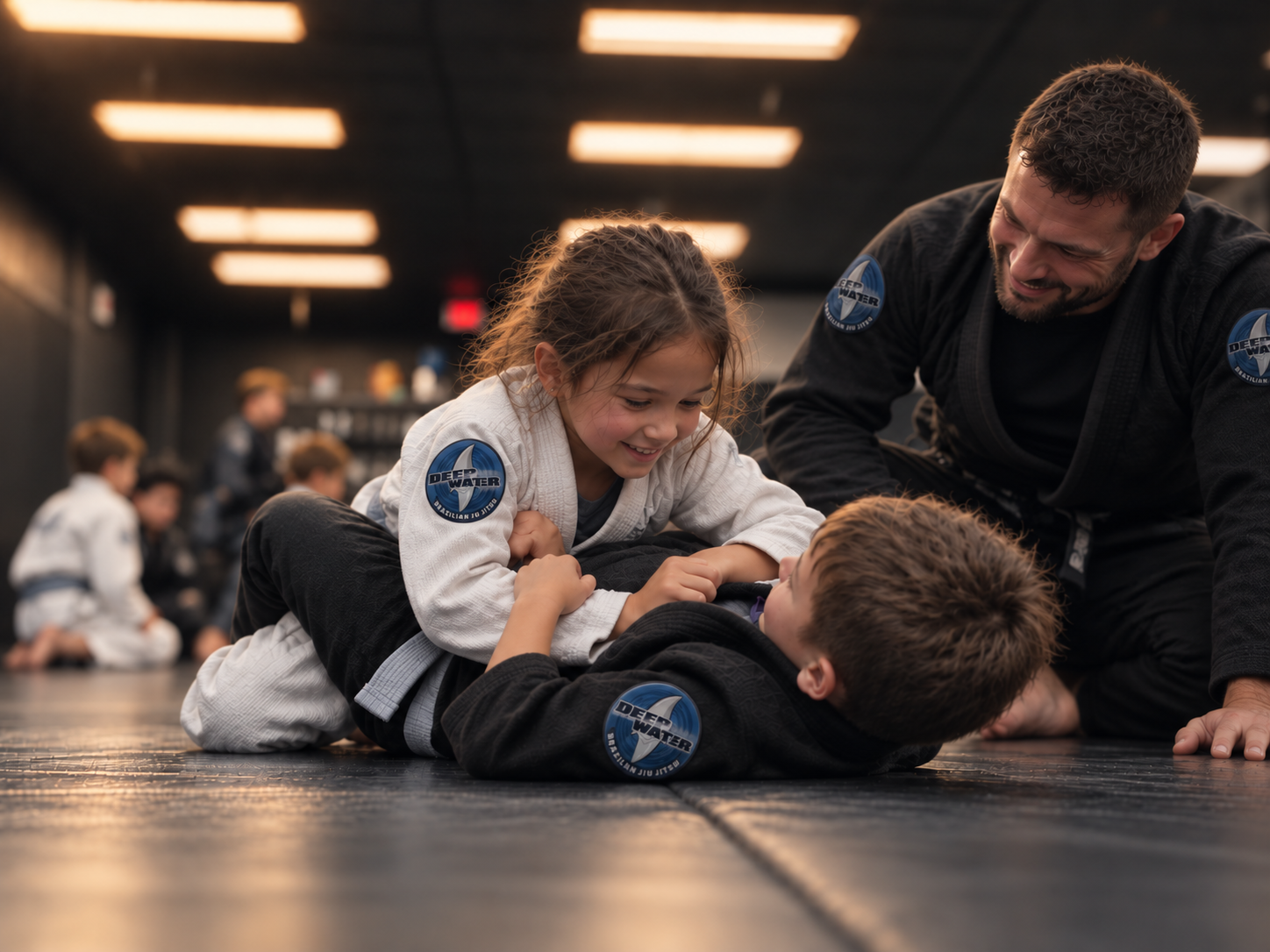
At Deep Water BJJ in Harrisburg, children train Brazilian Jiu-Jitsu.
We are not using martial arts terminology as decoration around a general children’s activity.
The goal is for children to learn real BJJ while developing the habits needed to train it responsibly.
Our current Kids BJJ program serves children ages 6–9 and 10–14.
Every new child begins in Kids Fundamentals.
That gives children a defined place to start developing:
- Brazilian Jiu-Jitsu skills.
- Attention.
- Training habits.
- Responsibility.
- Comfort working with appropriate challenge.
As children develop, coaches may approve progression into Kids CAP, where greater challenge becomes appropriate.
That progression is not automatic.
Children do not move forward simply because enough calendar time has passed.
The goal is for the next level of training to make sense for the child receiving it.
Parents may watch their child’s trial class.
After enrollment, our regular Kids classes are normally student-only so children can focus on the coaches, participate independently, and become increasingly comfortable in the training environment.
That is how we have chosen to structure the program.
You should still evaluate it the same way this article recommends evaluating anybody else.
Watch the coaching.
Watch the children.
See what they are learning.
See what happens when they struggle.
See whether the standards are real.
Then decide whether it feels like the right environment for your child.
Related Deep Water Resources
Kids Brazilian Jiu-Jitsu in Harrisburg
See how Deep Water’s Kids BJJ program develops real Brazilian Jiu-Jitsu skill through Kids Fundamentals, age-appropriate challenge, expectations, and coach-guided progression.
How to Choose a Martial Arts Academy in Harrisburg, PA
Learn what to compare across martial arts academies, including instruction, beginner development, culture, progression, pricing, and practical fit.
Start Here
Learn how trial classes work and what to expect before the first visit.
Martial Arts Pricing & Membership
Understand how Deep Water handles membership options, exact pricing, terms, and the decision after a trial.
Final Thought
Parents are right to want confidence.
Focus.
Discipline.
Responsibility.
Fitness.
Self-defense capability.
Those are good things to want for your child.
But do not choose a martial arts program because those words appear in big letters on a website.
Look underneath them.
What will your child actually be asked to do that could help those qualities develop?
Will they learn a real skill?
Will they have to listen?
Will they have to practice?
Will somebody correct them?
Will they work responsibly with another person?
Will they encounter things that do not come easily?
Will they be expected to try again?
Will the challenge increase as they become capable of handling more?
Will they have a reason to look back six months from now and realize:
I can do things now that I couldn’t do before.
That is what I would look for.
Because the strongest kids martial arts program is not the one that makes the biggest promises about the child your son or daughter might become.
It is the one that gives them meaningful things to learn, practice, earn, and become capable of doing.