
TL;DR
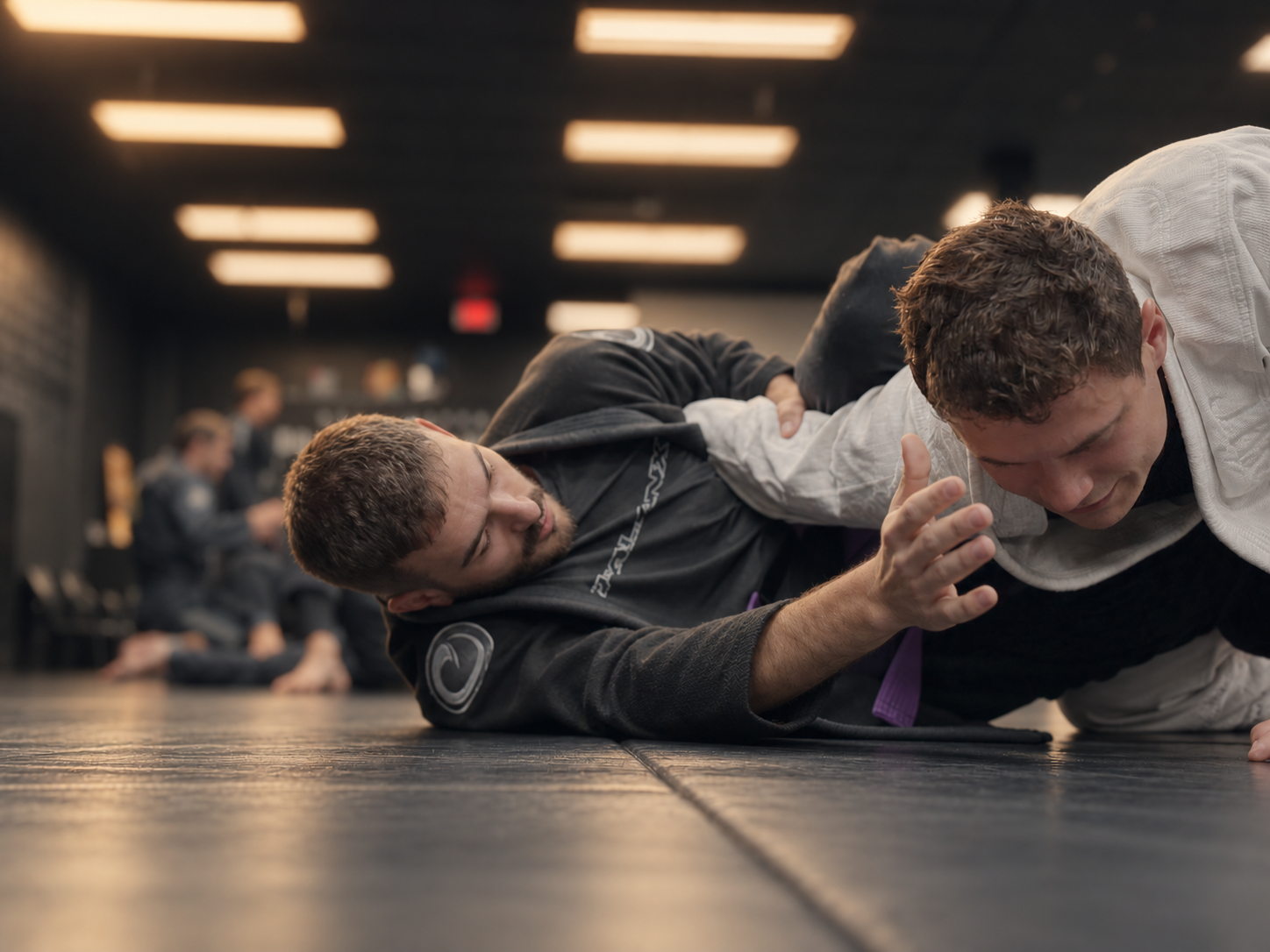
Brazilian Jiu-Jitsu, or BJJ, is a martial art and combat sport built around controlling another person through position, leverage, timing, pressure, and submissions. Although BJJ is best known for ground fighting, it also includes takedowns, clinch work, grip fighting, escapes, positional control, and the ability to apply chokes and joint locks. Effective BJJ is not about making size or strength irrelevant; it is about using technique and positioning so you are not relying on strength alone.
Key Takeaways
- Brazilian Jiu-Jitsu focuses on gaining control through position before attacking with submissions such as chokes and joint locks.
- BJJ developed from Japanese jujutsu and Kodokan judo before evolving into a distinct martial art in Brazil.
- Position, leverage, timing, pressure, balance, and control are central to making BJJ work against resistance.
- Gi and No-Gi BJJ use the same underlying grappling principles but create different gripping, control, and tactical problems.
- BJJ can be trained for self-defense, grappling competition, MMA, fitness, or long-term skill development, and beginners are not expected to understand the positions or terminology before they start.
What Is Brazilian Jiu-Jitsu?
Brazilian Jiu-Jitsu, often shortened to BJJ, is a martial art and combat sport built around controlling another person through position, leverage, timing, pressure, and submissions.
The simplest way to understand it is this:
Brazilian Jiu-Jitsu teaches you how to handle a fight or grappling situation when it reaches close contact and the ground.
That does not mean BJJ ignores standing techniques. Takedowns, grip fighting, clinch work, balance, and the ability to bring someone to the ground can all matter. But BJJ became famous because of what it teaches after the fight gets there: how to escape bad positions, control dominant positions, defend yourself, and attack with submissions like chokes and joint locks.
To someone watching for the first time, BJJ can look confusing. Two people may be tangled together, one person may be on top, the other may be on bottom, and the action may look slower than striking. But underneath that, there is a constant battle over posture, grips, angles, weight, space, timing, and control.
BJJ is not magic. It does not make size, strength, athleticism, or toughness irrelevant. That is a common exaggeration.
What it does is give a trained person a way to use leverage, positioning, and technique so they are not relying only on strength. That is why Brazilian Jiu-Jitsu became so influential in self-defense, grappling competition, and modern mixed martial arts.
Where Did Brazilian Jiu-Jitsu Come From?
Brazilian Jiu-Jitsu has roots in Japanese jujutsu and Kodokan judo, then developed into its own distinct martial art in Brazil.
The short version is:
- Japanese jujutsu influenced judo.
- Judo traveled internationally.
- Judo and jiu-jitsu were taught in Brazil.
- Brazilian practitioners adapted, tested, organized, and developed the art into what became Brazilian Jiu-Jitsu.
That history is often told through one simple story: Mitsuyo Maeda, a Japanese judoka, taught Carlos Gracie, and the Gracie family developed Brazilian Jiu-Jitsu from there.
That story matters, but it is too clean if told by itself.
The Gracie family played a major role in the development and global spread of Brazilian Jiu-Jitsu. Carlos Gracie, Hélio Gracie, and later generations of the family helped promote the art through teaching, challenge matches, vale tudo fights, and eventually the early UFC era. Their impact is enormous.
But BJJ history is not only one family and one moment. Japanese martial artists were active in Brazil in the early twentieth century. Judo was often referred to by names such as “Kano jiu-jitsu” during that period. Brazilian grappling also developed through other teachers, students, challenge matches, military and police training environments, and non-Gracie lineages such as the Luiz França and Oswaldo Fadda line.
A more accurate way to say it is this:
Brazilian Jiu-Jitsu came from Japanese grappling arts, especially Kodokan judo, then became a Brazilian combat sport and martial art through decades of adaptation, competition, teaching, and real testing.
Why Judo Matters to BJJ History
To understand BJJ, you need to understand judo’s influence.
Jigoro Kano founded Kodokan judo in Japan in 1882. Judo came from older jujutsu traditions, but Kano organized it into a more modern educational and athletic system. Judo included throws, pins, chokes, armlocks, and groundwork.
Over time, Olympic judo became strongly associated with standing throws and explosive takedowns. Brazilian Jiu-Jitsu developed with much more emphasis on extended ground fighting.
That difference matters.
In judo, a beautiful throw can define a match. In Brazilian Jiu-Jitsu, a takedown matters, but the fight often continues into guard passing, sweeps, positional control, escapes, and submissions. The ground is not a quick stopping point. It is where much of the art happens.
That is one reason BJJ became so useful in mixed martial arts. It answered a question many martial arts had not taken seriously enough:
What happens if the fight does not stay standing?
Why BJJ Became Famous
Brazilian Jiu-Jitsu became globally famous because it challenged what people thought fighting looked like.
Before the early UFC events, many casual martial arts fans assumed the best fighter would usually be the strongest striker, the biggest athlete, or the person with the most dramatic-looking techniques. Then Royce Gracie used Brazilian Jiu-Jitsu to defeat larger opponents under early mixed-rules conditions.
That did not mean BJJ was the only martial art that mattered. Modern MMA proved the opposite. Fighters now need striking, wrestling, grappling, cage work, defense, conditioning, and the ability to connect all of it.
But the early success of BJJ forced the martial arts world to take grappling seriously.
It showed that a trained grappler could close distance, survive strikes, control position, and submit someone who did not understand the ground. That changed martial arts training permanently.
Today, BJJ is practiced for many reasons:
- Self-defense
- Sport competition
- MMA development
- Fitness
- Problem-solving
- Confidence
- Challenge
- Community
- Long-term skill development
Some students compete. Some never compete. Some train for self-defense. Some train because they enjoy the technical puzzle. Some start later in life and keep going for years because there is always another layer to learn.
The Core Idea: Position Before Submission
One of the most important ideas in Brazilian Jiu-Jitsu is position before submission.
A submission is a finishing hold, usually a choke or joint lock. But good BJJ is not just grabbing for submissions from anywhere. A skilled grappler usually works to improve position first.
That means moving from a less controlled position to a more controlled one.
For example:
- From bottom to top.
- From inside someone’s guard to past their legs.
- From side control to mount.
- From mount to the back.
- From a loose control to a tighter control.
The better your position, the more options you have. The worse your opponent’s position, the fewer safe choices they have.
This is why BJJ can look patient. A good practitioner may spend time controlling hips, isolating an arm, breaking posture, changing an angle, or removing space before attacking.
To beginners, that can feel slow.
To someone who understands the art, that is where the fight is being won.
The Major Positions in Brazilian Jiu-Jitsu
There are many positions in BJJ, but beginners should understand the big ones first.
Guard
Guard is when one person is on bottom using their legs to control, manage distance, defend, sweep, or attack submissions.
This is one of the positions that makes BJJ different from many other grappling arts. Being on bottom is not automatically losing. It can be dangerous if the top person knows how to strike or pass, but in BJJ the bottom person can still attack and reverse the situation.
Common guards include closed guard, open guard, half guard, butterfly guard, and many others.
The main idea is that the legs are not just sitting there. They are frames, hooks, barriers, levers, and tools for control.
Side Control
Side control is when the top person has passed the legs and is controlling from the side of the bottom person’s body.
This is usually a strong top position. The person on top can apply pressure, limit movement, attack submissions, transition to mount, or move to the back.
For the person on bottom, side control can feel heavy and frustrating. Escaping requires frames, timing, hip movement, and the ability to create space without exposing something worse.
Mount
Mount is when the top person is sitting over the bottom person’s torso with strong control.
This is one of the most dominant positions in BJJ and in fighting. The top person has gravity, pressure, and attacking options. The bottom person must protect their neck and arms while trying to escape.
Mount teaches one of BJJ’s most important lessons:
Being underneath someone who understands control is a serious problem.
Back Control
Back control is often considered one of the strongest positions in Brazilian Jiu-Jitsu.
When someone takes your back, they are behind you with access to your neck while you have limited ability to see, strike, or turn toward them. This is why back control is so heavily valued in both BJJ competition and MMA.
Many of the highest-percentage submissions in BJJ come from the back, especially rear naked chokes and collar chokes in the gi.
Knee on Belly
Knee on belly is a control position where the top person places a knee across the opponent’s torso while maintaining posture, pressure, and mobility.
It can be uncomfortable, but its real value is not just discomfort. It lets the top person create pressure, force reactions, transition, or attack while staying mobile.
Turtle
Turtle is when a person is on their knees and elbows or hands, usually trying to avoid having their guard passed, avoid points, or build back up.
Turtle can be defensive, transitional, or strategic depending on the athlete. In BJJ and MMA, it can lead to back takes, front headlocks, turnovers, stand-ups, and scrambles.
Common Brazilian Jiu-Jitsu Submissions
Submissions are techniques designed to make the opponent tap, which means they signal that they concede before injury or loss of consciousness occurs.
The tap is important. It allows people to train hard while preserving their training partners.
Common BJJ submissions include:
Chokes
Chokes attack the neck. Some restrict blood flow. Some restrict breathing. Some do both.
Common examples include rear naked chokes, triangle chokes, guillotines, bow-and-arrow chokes, cross-collar chokes, and arm triangles.
Chokes are a major part of BJJ because they can work even against stronger opponents when the position, angle, and pressure are correct.
Armlocks
Armlocks attack the elbow or shoulder.
Common examples include armbars, kimuras, Americanas, and straight armlocks.
Good armlocks usually require control of the body first. If the opponent can freely turn, posture, or pull away, the submission becomes much harder to finish.
Leg Locks
Leg locks attack the ankle, knee, or hip line depending on the technique.
Common examples include straight ankle locks, kneebars, toe holds, and heel hooks.
Leg locks are a major part of modern grappling, especially no-gi submission grappling. They are also more rule-dependent than many other submissions. Some leg locks are not allowed for certain ages, ranks, or competition formats.
Beginners should not treat leg locks casually. They require control, knowledge, and responsible training habits.
Gi vs. No-Gi BJJ
Brazilian Jiu-Jitsu is commonly trained in two formats: gi and no-gi.
Gi BJJ
In gi training, students wear a jacket, pants, and belt. The gi can be gripped and used for control, sweeps, guard work, chokes, and positional strategy.
Gi training often slows certain exchanges down because grips can create strong control. It also introduces attacks and defenses that do not exist without the uniform, especially collar and lapel-based techniques.
No-Gi BJJ
In no-gi training, students usually wear shorts and a rash guard or athletic shirt. Because there is no jacket to grip, control depends more on underhooks, overhooks, head position, body locks, wrist control, leg entanglements, and direct body positioning.
No-gi tends to feel faster and more slippery. It also connects closely with wrestling, submission grappling, and MMA.
Neither format is “real” while the other is fake. They teach overlapping but different skills. Gi can sharpen grip fighting and control. No-gi can sharpen body control, scrambles, and movement without cloth grips.
A well-rounded BJJ student can benefit from understanding both.
What Does “Rolling” Mean?
Rolling is live grappling practice.
It is the BJJ version of sparring, but the goal is not to hurt your partner. The goal is to apply what you know against resistance while your partner is trying to do the same.
Rolling can be light, technical, situational, competitive, or intense depending on the setting and the people involved.
For beginners, rolling should not be treated like a fight for survival. Good training helps students understand positions, goals, and safety before expecting them to handle full live rounds.
The point of rolling is not just to “win the round.”
The point is to learn what works, what fails, what you missed, where you panic, where your timing is late, and what you need to improve next.
That is why BJJ can be humbling and addictive at the same time. The feedback is honest.
How Brazilian Jiu-Jitsu Competition Works
BJJ competitions vary by organization, ruleset, uniform, age, belt level, and format. But most sport BJJ matches are won in one of three ways:
- Submission
- Points
- Referee decision or tie-breaking criteria, depending on the ruleset
Under common IBJJF-style scoring, points reward positional progress. The exact details can be technical, but the basic idea is simple:
- Takedowns, sweeps, and knee-on-belly are commonly worth 2 points.
- Guard passes are commonly worth 3 points.
- Mount and back control are commonly worth 4 points.
That scoring system tells you something important about BJJ’s values.
The sport rewards moving to better positions.
It is not only about hunting submissions. It is about controlling the fight in a way that creates safer, stronger attacking opportunities.
This is why a person watching BJJ should pay attention to position, not just submission attempts. Someone may be winning even if they are not close to finishing yet, because they are controlling the direction of the match.
What Belts Mean in Brazilian Jiu-Jitsu
BJJ has a belt system, but belts should not be understood as decoration.
In adult Brazilian Jiu-Jitsu, the common belt progression is:
- White
- Blue
- Purple
- Brown
- Black
Beyond black belt, there are advanced degrees and coral/red belt ranks, but those represent decades of involvement and contribution.
Kids have a different belt system with additional colors before adult ranking.
The important thing for beginners to understand is this:
BJJ promotions usually take time.
That is not a flaw. It is part of why the ranks mean something. Brazilian Jiu-Jitsu is difficult to fake because students eventually have to apply their skills against resisting people.
A belt does not mean someone is invincible. It does not mean every practitioner at that belt is identical. But in a serious academy, rank should reflect a combination of technical understanding, training time, performance, consistency, decision-making, and readiness for the next level of responsibility.
Common BJJ Terms Beginners Hear
BJJ has its own vocabulary. You do not need to know all of this before your first class, but these terms help you understand what people are talking about.
Tap: The signal that you are conceding, usually by tapping your partner or the mat.
Roll: Live grappling practice.
Guard: A bottom position where the legs are used to control, defend, attack, or sweep.
Pass: Getting past someone’s guard into a more dominant top position.
Sweep: Reversing from the bottom, usually from guard, to come on top.
Submission: A choke or joint lock that forces the opponent to tap.
Frame: A defensive structure using your arms or legs to create space and prevent pressure.
Base: Balance and stability that make it hard to sweep or knock someone over.
Posture: Body position that helps you stay safe, strong, and difficult to control.
Shrimp: A hip escape movement used to create space and recover position.
Underhook: An arm position underneath your opponent’s arm that can help with control, escapes, takedowns, and guard work.
Hooks: Legs or feet used to control an opponent, especially from back control or guard.
Again, you do not need to memorize these before training. You learn the language by training.
What Beginners Usually Misunderstand About BJJ
Misconception 1: BJJ is only ground fighting
BJJ is best known for ground fighting, but good BJJ also includes standing grip fighting, takedown awareness, balance, clinch work, and the ability to decide when and how the fight gets to the ground.
Still, BJJ’s deepest specialty is what happens once body contact and ground control become unavoidable.
Misconception 2: Smaller people automatically beat bigger people
Technique can help a smaller person deal with a larger person, but size and strength still matter.
The honest version is better:
BJJ gives smaller people tools they would not otherwise have.
That does not mean training removes physical reality. It means skill changes the problem.
Misconception 3: Submissions are the whole point
Submissions matter, but beginners who only chase submissions usually miss the bigger lesson.
Control comes first. Escapes matter. Defense matters. Position matters. Timing matters. A submission is often the result of several smaller battles that happened before it.
Misconception 4: You need to be in shape before starting
You do not need to be in perfect shape to begin BJJ.
Training will challenge you, and you will likely get tired. That is normal. But waiting until you are “ready” often becomes a way to avoid starting at all.
A good beginner environment should help you start at the right level and build from there.
Misconception 5: Rolling is just fighting
Rolling is live practice. It can be intense, but it should still be training.
The goal is not to injure your partner or prove toughness every round. The goal is to develop skill under resistance.
That distinction is one of the things that separates good training from chaos.
Why BJJ Is Useful for Self-Defense
Brazilian Jiu-Jitsu is useful for self-defense because it teaches close-range control, escapes, positional awareness, and what to do if a confrontation goes to the ground.
Real self-defense is complicated. It can involve strikes, weapons, multiple people, legal consequences, emotional stress, and the need to leave rather than “win.”
So BJJ should not be sold as a guaranteed answer to every self-defense problem.
But it does teach valuable skills:
- How to stay calmer in close contact.
- How to protect yourself from bad positions.
- How to escape from underneath someone.
- How to control another person without relying only on striking.
- How to recognize danger when someone is controlling your posture, hips, arms, or neck.
- How to keep thinking under pressure.
Those are not abstract benefits. They are physical skills that have to be practiced.
Why BJJ Is So Important in MMA
Brazilian Jiu-Jitsu changed mixed martial arts because it proved that ground fighting could decide the outcome of a fight.
Early MMA showed that many skilled strikers were not prepared for takedowns, guard work, positional control, or submissions. Over time, that forced everyone to adapt.
Modern MMA fighters cannot usually rely on pure BJJ by itself. They need wrestling, striking, cage work, conditioning, ground-and-pound, and the ability to blend disciplines.
But BJJ remains one of MMA’s core foundations because the threat of takedowns, submissions, sweeps, back control, and ground escapes changes everything else.
A fighter who does not understand BJJ is vulnerable in ways they may not even recognize until it is too late.
Is Brazilian Jiu-Jitsu Right for Beginners?
Brazilian Jiu-Jitsu can be a strong choice for beginners because it gives people a structured way to learn physical problem-solving.
You do not need to know the positions before starting.
You do not need to know the terminology.
You do not need to be flexible.
You do not need to be an athlete.
You do not need to want to compete.
But you do need patience.
BJJ can be frustrating at first because you are learning how to move in situations that may feel unfamiliar. You may not understand what is happening right away. You may get stuck in positions that feel impossible to escape. You may learn a technique and then struggle to use it when your partner resists.
That does not mean you are bad at BJJ.
That is BJJ.
The art gives you problems. Training gives you a way to solve them.
How BJJ Is Commonly Trained
A typical BJJ class may include:
- Warmups or movement drills
- Technical instruction
- Partner drilling
- Situational training
- Live rolling
- Questions and coaching feedback
Different academies structure classes differently. Some are highly organized. Some are looser. Some focus heavily on sport competition. Some emphasize self-defense. Some are beginner-friendly. Some expect new students to figure things out quickly in mixed-level rooms.
That is why the academy matters.
The art may be called the same thing from school to school, but the student experience can be very different depending on how classes are taught, how beginners are introduced, how safety is handled, and whether students are actually being coached.
Brazilian Jiu-Jitsu at Deep Water BJJ in Harrisburg
At Deep Water Brazilian Jiu Jitsu in Harrisburg, adult beginners who are new to BJJ normally begin in Adult Intro.
That starting point matters because Brazilian Jiu-Jitsu can be overwhelming when a new student is thrown straight into too much information, too much resistance, and too little context.
The goal is not to make BJJ easy.
The goal is to help beginners understand the positions, movements, decisions, and training habits that make the art start to make sense.
If you are researching Brazilian Jiu-Jitsu because you are thinking about training, the best next step is not to memorize every position before you walk in.
It is to experience a class, ask questions, and see how the instruction feels.
Related Deep Water Resources
If you want to keep learning, these pages can help:
Brazilian Jiu-Jitsu Classes in Harrisburg
Learn how Deep Water teaches adult BJJ and how beginners start.
Start Here
See what to expect before your first class and how the trial process works.
Kids Brazilian Jiu-Jitsu
Learn how children begin training BJJ at Deep Water.
MMA Training in Harrisburg
See how Brazilian Jiu-Jitsu connects to the longer-term MMA pathway.
Frequently Asked Questions
Get direct answers to common beginner, parent, schedule, pricing, and training questions.
Final Thought
Brazilian Jiu-Jitsu is not just a collection of moves.
It is a way of understanding control.
You learn how positions work. You learn how leverage changes strength. You learn how to stay calm when someone is trying to control you. You learn how to escape, recover, advance, and attack with purpose.
That is why BJJ stays interesting for so many people.
There is always another position to understand, another detail to clean up, another problem to solve, and another level of control to develop.